Can donations be accounted for business expenses?

This page is also available in: 简体中文

It depends on who makes the donation. Individuals may claim a donation tax credit for eligible donations to approved donee organisations. Companies may be able to claim a deduction, subject to applicable limits. A sole trader’s personal donation is not a business expense.

Learn more: Not-for-profit organisation

This page is also available in: 简体中文

If a project is sold before it is completed, is the expenditure in the development phase of the project as an expense?

This page is also available in: 简体中文

Normally, if you are working on a project, it will be sold as inventory. The expenditure of developing the project will be included in Cost of Goods Sold, and it is not accounted for an expense.

This page is also available in: 简体中文

Does Bank Fee have GST?

This page is also available in: 简体中文

No, it doesn’t. Bank fees are exempt from GST because these fees defined as financial services, financial services are GST exempt.

This page is also available in: 简体中文

How do I record the cost on business meal with my customer?

This page is also available in: 简体中文

Regarding the business meal expense, you can only Record 50% of the expense as a deduction because it has a significant private element. Even if you think the private element was more or less than 50% of the expense, you can only claim 50% of the expense.

This page is also available in: 简体中文

How to choose GST filing frequency?

This page is also available in: 简体中文

GST is New Zealand’s goods and services tax, with a standard rate of 15%. GST-registered businesses generally charge GST on taxable goods and services supplied in New Zealand. However, some supplies may be zero-rated, GST-exempt or outside the scope of GST. For example, certain financial services are GST-exempt.

A business must generally register for GST if its taxable turnover exceeded $60,000 in the previous 12 months or is expected to exceed $60,000 in the next 12 months. Businesses below this threshold may register voluntarily.

Businesses with annual taxable sales of up to $500,000 may file six-monthly, while those with sales of up to $24 million may file two-monthly. Businesses with sales exceeding $24 million must file monthly. Eligible businesses may also choose to file more frequently.

All turnover thresholds stated above are GST-exclusive.

This page is also available in: 简体中文

Does the freight cost of export include GST?

This page is also available in: 简体中文

The easiest way is to look at the invoice provided by the supplier. Generally speaking, exporting freight cost does not include GST, which are zero-rated GST. However, there are several types of exporting freight cost, so some of them might include GST.

This page is also available in: 简体中文

Which insurance does not need to pay GST?

This page is also available in: 简体中文

As far as we know, life insurance premiums are fully exempt from GST.

This page is also available in: 简体中文
Do I need to pay GST and withholding tax for the cost of designing a house by an overseas online company?

This page is also available in: 简体中文

From 1 December 2019, GST will apply to sales of goods and services imported into New Zealand, regardless of the value. When purchasing overseas goods and services from online platforms, if the value is less than $1,000, GST will generally be collected by overseas suppliers. If the value is greater than $1,000, GST and customs duties will be collected by New Zealand Customs.

Paying withholding tax depends on whether the service is under the service category that needs to be charged. For example, a loyalty fee must be charged.

This page is also available in: 简体中文

I buy a second-hand good from a private person without a receipt, how can I claim GST?

This page is also available in: 简体中文

You can use the actual purchase value of the second-hand good when file GST.

This page is also available in: 简体中文

What is GST in New Zealand?

This page is also available in: 简体中文

GST is a tax added to the price of most goods and services, including imports.


This page is also available in: 简体中文

What’s the GST rate in New Zealand?

This page is also available in: 简体中文

The normal GST rate is 15%. This rate is being increased from 12.5% to 15% since 1 October 2010.


This page is also available in: 简体中文

What is the tax code of WT?

This page is also available in: 简体中文

WT stands for withholding tax. It is generally applicable to contractors receiving scheduler payments, excluding employees receiving salary or wages. Employers withhold contractors’ personal income tax. Contractors using the tax code of WT need to fill in IR330C. In addition, the contractors will pay ACC levies by themselves rather than by the employers.

This page is also available in: 简体中文

When to pay provisional tax?

This page is also available in: 简体中文

The due dates of the provisional tax payments depend on which option you use and if you’re GST registered. If you use the standard or estimation option, you’ll generally pay 3 instalments of provisional tax., which are 28 August, 15 January, and 7 May. If you use accounting income method, your due dates for paying and filing your statement of activity will line up with your GST due dates. If you use the ratio option you’ll pay your provisional tax in 6 instalments, once every two months. If you pay late, underpay or fail to pay the provisional tax, you will be charged for fines and interest.


For details of provisional tax, see IR316.

This page is also available in: 简体中文

Is there a secondary income that pays more taxes than just one income?

This page is also available in: 简体中文

If you have a second job in addition to your main employment in New Zealand, you will generally need to submit an IR330 form to your second employer. Select the appropriate secondary tax code, such as SB, S, SH, ST or SA based on your estimated total annual income.
If your selected tax code results in more tax being deducted than you are required to pay, Inland Revenue will refund the overpaid tax at the end of the tax year.

This page is also available in: 简体中文

When I need to use the highest income tax rate of 39%?

This page is also available in: 简体中文

When your income is over $180,000, and only the excess part is taxed on 39% . You can use our Tax Calculator to calculate your income tax.

This page is also available in: 简体中文

If a child has income from helping neighbors mowing the lawn. Does he/she need to pay tax?

This page is also available in: 简体中文

According to the interpretation of Children’s exempt income from IR3G, if for the tax year you were 14 or under, or were 15, 16 or 17 and still attending school, or turned 18 on or after 1 January in the previous tax year and continued to attend school.

If you receive income that has not had tax taken out before you receive it eg. worked around the home of a neighbour or family friend, and that work was not part of a business that they carry on,  and your total income from these sources is less than $2,340 for the tax year, this income is exempt from tax and is not included in your return. You are not required to file a return just because you earn this type of income. If you earn $2,340 or more, the exemption does not apply and you will need to file a return and pay tax on all the income, not just the amount that exceeds the exemption.

This page is also available in: 简体中文

How much tax do I pay for the second job if I hold a Partner of Open Work Visa?

This page is also available in: 简体中文

The second job requires to use the Tax Code of S. The specific tax rate will vary according to the frequency and amount of salary payment. The tax can be calculated by using the PAYE calculator provided by IRD.

This page is also available in: 简体中文

Can chattels be depreciated? Can the building be depreciated?

This page is also available in: 简体中文

Chattels used in a rental property may be depreciated at IRD rates. From the 2025 income year, the depreciation rate for most buildings is 0%.
However, eligible new commercial or industrial buildings, and qualifying improvements first available for use on or after 22 May 2025, may claim a one-off 20% Investment Boost deduction. Second-hand New Zealand buildings and residential rental buildings are excluded.
Chattel rates can be checked using IRD’s Depreciation Rate Finder.

This page is also available in: 简体中文

What’s income tax rate for company?

This page is also available in: 简体中文

From 1 October 2010, the company income tax rate was reduced to 28% till now.


This page is also available in: 简体中文

What’s income tax rate for trust?

This page is also available in: 简体中文

From 1 April 2024, trustee income that is not distributed to beneficiaries is generally taxed at 33% if the trust earns $10,000 or less in a tax year after annual deductions and before losses brought forward.

If it earns more than $10,000, the trustee tax rate is generally 39%. Some trusts and estates qualify for exceptions, and beneficiary income may be taxed differently.

Please refer to Inland Revenue’s current trustee income tax rates or contact us for advice based on your circumstances.

This page is also available in: 简体中文

Does compensations paid to employees need to deduct PAYE?

This page is also available in: 简体中文

Generally, if there is a clause of compensations in the employment agreement, you need to compensate the employee according to the contract. You need to deduct PAYE for the compensation as same as salary.

This page is also available in: 简体中文

Are fixed-term employees and causal employees paid during public holidays?

This page is also available in: 简体中文

Fixed-term employees have the same public holiday rights as permanent full-time and part-time employees. If they do not work on public holidays, they will be paid according to their normal working salary. If they need to work on public holidays, they will be paid 1.5 times normal salary. Causal employees generally have no wages if they do not work on public holidays, because their working hours are not fixed, so they will be paid 8% of the holiday pay with their wages.

This page is also available in: 简体中文

Can I cash up my annual leave?

This page is also available in: 简体中文

Employees can ask their employer to pay out in cash, up to one week of their four weeks’ minimum entitlement to annual holidays per year for each entitlement year. They can do this all at once, or can make multiple requests to cash-up until the entire one week is cashed up. Some employees do not or rarely take annual leave, so they will negotiate with their employers and require one week of annual leave to be paid directly in the form of wages.

An employer can’t:

  • pressure an employee into cashing up holidays
  • raise it in wage or salary negotiations
  • make cash up a condition of employment
  • put a cash up request into an employment agreement, but can include the process for making a request.

This page is also available in: 简体中文

How to deal with unused sick leave?

This page is also available in: 简体中文

Any unused sick leave at the end of a 12-month period can be carried over and added to their next year’s entitlement. The maximum amount of sick leave that can be accumulated under the Holidays Act 2003 is 20 days. The employer and employee can agree that sick leave can accumulate to more than 20 days through an employment agreement. Unused sick leave can’t be cashed-up or be part of any final payment to the employee when they leave, unless this is in the employment agreement.

This page is also available in: 简体中文

How to pay for annual leave?

This page is also available in: 简体中文

Generally, when employees work for less than one year, their annual leave is accumulated at 8% of the employees’ before-tax earnings, then after one year of work, they are entitled to four weeks’ annual leave each year. If an employee wants to take annual leave before they become entitled to, it depends on if the employer allows the employee to take annual leave in advance, that is, if the ‘annual leave in advance’ item is included in the employment contract signed with the employer.

This page is also available in: 简体中文

How to pay for Holiday Pay to casual workers?

This page is also available in: 简体中文

For casual workers, the Holiday Pay can be included in each settlement of the salary, and the total amount of the salary and the Holiday Pay is used to calculate the PAYE.

This page is also available in: 简体中文

What is the difference between Casual worker and Part-time worker in terms of PAYE and contract?

This page is also available in: 简体中文

PAYE will not be affected. PAYE is calculated based on the employee’s tax code, payment frequency and payment amount. It can be calculated through the PAYE Calculator provided by IRD. However, casual workers are generally paid Holiday Pay together with wages due to uncertain working hours, so they are different from long-term part-time workers.

In terms of the contract, the two are generally different. Because the working hours of casual workers are not fixed, the contract may not specify fixed working hours, but part-time workers generally have fixed working hours per week, and the contract is generally noted.

This page is also available in: 简体中文

How to calculate PAYE for bonus payments to employees?

This page is also available in: 简体中文

The one-time bonus payments to employees are calculated according to the method of lump sum payments. The PAYE is calculated on the whole payment.

This page is also available in: 简体中文

Do I need to fill in a employee’s date of birth for Payroll?

This page is also available in: 简体中文

If you’re using software, it is required. If you’re filing on the IRD website, it is not currently required.

This page is also available in: 简体中文

Is there still a 90-day trial period for hiring new employees?

This page is also available in: 简体中文

Yes. Since 23 December 2023, employers of any size can agree with a new employee to a trial period of up to 90 calendar days.

The trial clause must be included in a written employment agreement signed before the employee starts work. It cannot be used if the employee has worked for the employer before or is employed on an AEWV.

For other conditions, please refer to Employment New Zealand.

This page is also available in: 简体中文

How can I choose tax code for employee?

This page is also available in: 简体中文

The employer cannot choose the tax code on behalf of employee. Before the employee’s first wage payment, you need to ask the employee to fill and sign the IR330 Tax code declaration form. According to the form’s instruction, the employee will choose the right tax code by him/herself.

This page is also available in: 简体中文

When does employee entitle to have sick leave?

This page is also available in: 简体中文

Based on the current employment law, the employee is entitled to 5 days’ sick leave if having six months’ current continuous employment with the same employer.

This page is also available in: 简体中文

Which entity is better for paying taxes for selling investment properties?

This page is also available in: 简体中文

No single ownership structure is suitable for every investment property. Holding property personally or through a company, LTC or trust can have different implications for tax, financing, asset protection, administration and profit distribution.
Changing the ownership structure after purchase may be treated as a sale and may result in tax, legal and refinancing costs. The appropriate structure should therefore be considered before signing the purchase agreement, taking into account the investor’s income, co-owners and long-term plans.
If you would like to understand which structure may suit your circumstances, please contact us about our Tax Risk Assessment service.

This page is also available in: 简体中文

Can one of two buyers use KiwiSaver if the other buyer is not eligible?

This page is also available in: 简体中文

Yes. KiwiSaver first-home withdrawals are still available. If one buyer is eligible, they may apply to withdraw their own KiwiSaver savings even if the other buyer is not eligible.

The applicant generally needs to have been a KiwiSaver member for at least three years and must leave $1,000 in their account.

Tips: The First Home Grant is a separate programme and closed to new applications on 22 May 2024.

This page is also available in: 简体中文

Does the bright-line test apply when a family trust sells its main home?

This page is also available in: 简体中文

A main home held by a family trust may qualify for the main-home exclusion under the bright-line test. The property must be the main home of a beneficiary, and the principal settlor must either have no other main home or use the property being sold as their main home.
The required occupancy and property-use criteria must also be met. The exclusion may not apply if there is a regular pattern of buying and selling homes, significant rental use, or the principal settlor has another main home.

This page is also available in: 简体中文

Does a family trust have to file taxes every year? There is only real estate in the trust.

This page is also available in: 简体中文

Not always. A trust that earns taxable income will generally need to file an IR6 return. If the trust only holds a home occupied by a beneficiary, receives no rent or other material income, and meets the non-active trust criteria, it may submit an IR633 form to IRD.

Once confirmed by Inland Revenue, annual income tax returns are generally not required until the trust becomes active again.

This page is also available in: 简体中文

Do I need to pay tax when I sell my main home?

This page is also available in: 简体中文

If the property was genuinely used as your main home and was not purchased with an intention to resell for profit, any gain on sale will generally not be taxable.
However, other property tax rules may apply if there is a regular pattern of property sales, development or subdivision, rental use, or an association with a property dealer, developer or builder.

This page is also available in: 简体中文

I have a residential rental property, does the loan repayment can be offset the rent income?

This page is also available in: 简体中文

Loan principal repayments cannot be deducted from rental income. From 1 April 2025, up to 100% of the interest may be deductible if the borrowing was used to earn rental income and the general deduction rules are met.
Interest must be apportioned where a loan has private use, and residential rental deductions may also be restricted by the ring-fencing rules.

This page is also available in: 简体中文

Do I have to calculate and pay for GST when I sell my main family home?

This page is also available in: 简体中文

Generally, no. The sale of a private main home is usually not subject to GST if the property was not part of a taxable activity and no GST was claimed when it was purchased or held.
GST may apply if the property was used for short-stay accommodation, property development or another GST-taxable activity. GST and income tax property rules must be considered separately.

This page is also available in: 简体中文

Will a company’s profit and loss affect personal benefit?

This page is also available in: 简体中文

Possibly. Income-tested entitlements such as Working for Families are calculated using family scheme income. Although a company is a separate entity, shareholder remuneration, dividends, and certain income or benefits from associated companies or trusts may still be included.
A company’s accounting loss does not automatically reduce family income. The result depends on the company’s ownership, income distributions and the family’s circumstances.

This page is also available in: 简体中文

If I have no employee, still need to pay ACC?

This page is also available in: 简体中文

Yes, although a company may not hire employees, you, as a shareholder and a director, run the company, so you are actually the employee of your company. You also receive shareholder salary, so you need to pay ACC.

This page is also available in: 简体中文

What are business name and trading name? Do I need to register them?

This page is also available in: 简体中文

A business name is the name that a company needs to officially register on the Company Office. A trading name is used for customers when doing business, and does not need to be registered. For avoiding malicious use of the same trading name by other businesses, you can protect it by registering and applying for Trademark.

This page is also available in: 简体中文

How to determine if I am a New Zealand tax resident?

This page is also available in: 简体中文

Regarding the tax residency status for individuals, it uses either the 183-day rule or the determination of whether you have a permanent place of abode in New Zealand.

The factors like having New Zealand nationality, having a bank account in New Zealand and contributing KiwiSaver will be considered when determining whether you have a permanent place of abode in New Zealand, but they are not certain factors. It will consider your other conditions.

This page is also available in: 简体中文

How to do if Company Annual Return is overdue?

This page is also available in: 简体中文

If the Company Office displays the “overdue” information, you need to submit the Company Annual Return as soon as possible. If you do nothing, your company will be forced to de-registration. If your company has unresolved tax issues, IRD will punish you.

This page is also available in: 简体中文

Do foreign people have to pay taxes on their income in New Zealand?

This page is also available in: 简体中文

It depends on whether foreign people are tax residents of New Zealand or not. If you are a New Zealand tax resident, you need to file not only your income in New Zealand, but also your overseas income. If you are not a New Zealand tax resident, you only need to file your income in New Zealand to IRD.

This page is also available in: 简体中文

If a company does not register a address for service, can it be found only by knowing the names of the company’s directors?

This page is also available in: 简体中文

There is currently no way to search the company’s address for service by the name of the company’s directors.

This page is also available in: 简体中文

If the registered address of a company, such as a restaurant, is different from the trading address, how can I find the real trading address?

This page is also available in: 简体中文

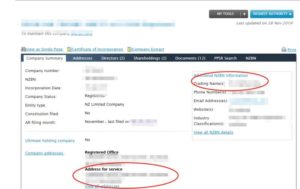
Under normal circumstances, the restaurant’s trading address will be displayed in the “Address for service” of Company Office, as shown in the figure below.

If the displayed address is incorrect, it is possible that the registrant has not completed the company information, and there is no other way to check it. However, you can also try to make a search using Google through Trading name (if available) for reference. You can see the trading name of the company as shown in the figure below, but if it is not provided, it is difficult to find it in other ways.

This page is also available in: 简体中文

Do I need to pay tax for the Guaranteed Childcare Assistance Payment (GCAP)?

This page is also available in: 简体中文

In general, most benefits in New Zealand will be paid after tax deductions. Moreover, the GCAP is generally paid directly to the early childhood education center, rather than directly to the parents.

This page is also available in: 简体中文

I am a New Zealand tax resident, what’s the tax deducted in my bank when I received bank deposit interest income?

This page is also available in: 简体中文

The tax deducted by the bank is Resident Withholding Tax (RWT). You should select the appropriate RWT rate 10.5%, 17.5%, 30%, 33% or 39% based on your estimated total taxable income for the year.
If you provide your IRD number but do not select a rate, the bank will generally deduct RWT at 33%. If you do not provide your IRD number, the rate is 45%. Inland Revenue will calculate any refund or tax payable at the end of the tax year.

This page is also available in: 简体中文

What is annual return? Do I have to do it?

This page is also available in: 简体中文

Annual return is different thing from a financial report. The Companies Register has general information record that the public can have access to view. If you are running a company, you must update the company’s information each year through an annual return.

This page is also available in: 简体中文

This page is also available in: 简体中文

Need help with accounting needs?

We are happy to help

Contact Us
×
Your Cart
Cart is empty.
Fill your cart with amazing items
Shop Now
$0.00
Keep Shopping