
On 1 April 2026, New Zealand’s KiwiSaver rules changed. If your payroll has not been updated, you may already be non-compliant.
KiwiSaver employer obligations are not new. But the rules have shifted in ways that catch a lot of NZ business owners off guard. The minimum employer contribution has risen from 3% to 3.5%, a new employer duty applies for 16 and 17-year-old workers, and another legislated increase is already on the horizon for 2028.
This guide covers what you need to know: contribution rates, ESCT, auto-enrolment rules, salary packaging traps, payday filing, and the penalties for getting it wrong.
What Are KiwiSaver Employer Obligations?
KiwiSaver is a government-backed workplace savings scheme, established by the KiwiSaver Act 2006 and launched in July 2007. Joining is voluntary for employees. But once they are enrolled, your obligations as their employer are mandatory and enforced by the IRD.
As an employer, you must:
- Automatically enrol eligible new employees in KiwiSaver
- Provide the KiwiSaver information pack (KS3) within 7 days of a new employee starting
- Give each new employee a KS2 deduction form on day one
- Deduct employee contributions from pay from the very first payday
- Make compulsory employer contributions (CECs) every time you pay wages or salary
- Pay Employer Superannuation Contribution Tax (ESCT) on your contributions
- Submit all contribution data to IRD via payday filing
Missing any of these steps can result in penalties, interest charges, and enforcement action from IRD. The stakes are higher than many employers realise.
2026 Rate Changes: What’s New and What’s Coming
This is the section most relevant to you right now.
| Period | Employer Min Rate | Employee Default | Your Action |
|---|---|---|---|
| Until 31 Mar 2026 | 3% | 3% | Legacy – now passed |
| 1 Apr 2026 onwards | 3.5% | 3.5% | Update payroll now |
| 1 Apr 2028 onwards | 4% | 4% | Budget ahead now |
From the first pay date on or after 1 April 2026, the minimum employer contribution rose from 3% to 3.5%. That applies to both employer and employee default rates.
Important: the rate applies from the first pay date after 1 April 2026, not the 1st of April exactly. If you run a monthly payroll and your next pay date is the 15th of April, that is when the new rate kicks in. Weekly and fortnightly payroll operators will have seen the change sooner.
This is part of a phased, legislated increase. The next step is 4% from 1 April 2028. That is not optional. Start budgeting for it now.
Contributions must be paid on top of an employee’s salary, not taken from it. We cover the exceptions in the Salary Packaging section below.
What does the 0.5% increase actually cost?
If you have 10 employees each earning $60,000 per year, the move from 3% to 3.5% adds $3,000 per year to your payroll costs before ESCT. For 50 employees at the same salary, that is $15,000 per year. Build this into your cashflow planning now.
Employees who want to keep contributing at 3% can apply to IRD for a temporary rate reduction. Valid for 3 to 12 months via myIR from 1 February 2026. If an employee does this, you can choose to lower your employer contribution to match. But you do not have to.
For help managing your PAYE return and payroll compliance, the PAS team can review your current setup and flag anything that needs updating.
Auto-Enrolment: Who Must Be Enrolled and When
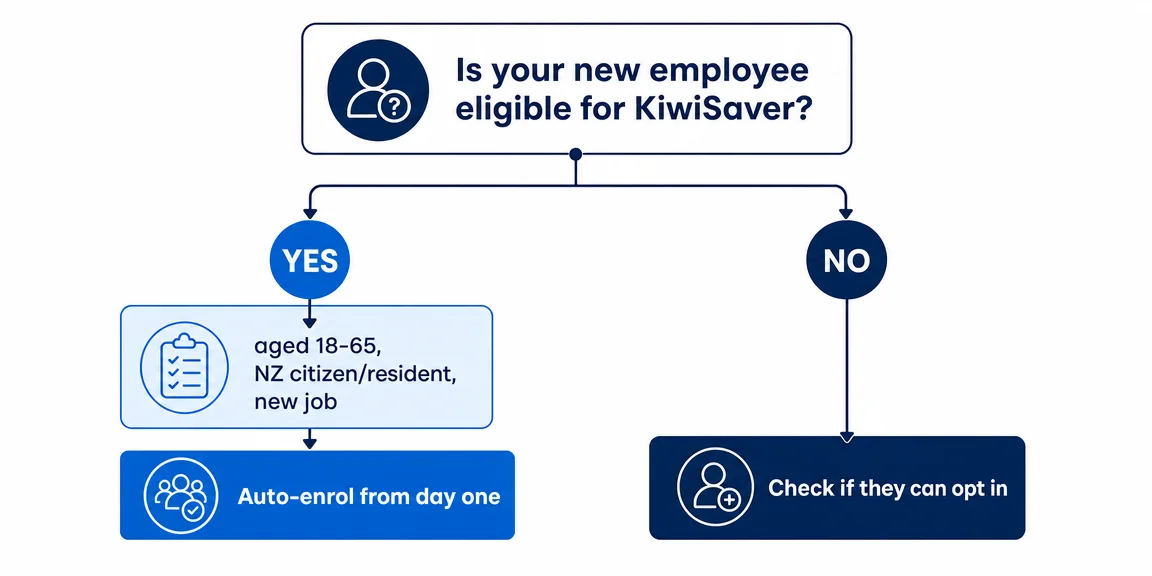
Automatic enrolment applies when a new employee is:
- Aged between 18 and 65
- A NZ citizen, permanent resident, or entitled to live in NZ indefinitely
- Starting a new job and not already enrolled in KiwiSaver
The following employees are not automatically enrolled, but can choose to opt in:
- Those aged under 18 or over 65
- Casual workers
- Employees on contracts of 28 days or less (beyond 28 days, automatic enrolment applies)
- Contractors and secondees
- Temporary, visitor, or student visa holders
New from 1 April 2026: 16 and 17-year-old employees
If an employee aged 16 or 17 is already a KiwiSaver member and making contributions from their pay, you must now make compulsory employer contributions for them. The auto-enrolment age threshold stays at 18. This group must have opted in themselves. But the employer obligation now applies once they do. Check your payroll for any affected staff.
Once auto-enrolled, employees have 14 to 56 days (2 to 8 weeks) to opt out. If they do, you must refund any contributions not yet sent to IRD. After day 56, they remain enrolled.
Keep all KiwiSaver records, KS2 forms, KS3 packs, opt-out requests, and savings suspension letters. Keep them for at least 7 years.
ESCT: The Tax on Your KiwiSaver Contributions
Employer Superannuation Contribution Tax (ESCT) is one of the least understood parts of the KiwiSaver system. It is also one of the most commonly miscalculated.
ESCT is a tax on your employer contribution, not the employee’s. You deduct it before the contribution reaches the employee’s KiwiSaver fund. This means the net amount credited to the employee’s account is less than 3.5% of their gross pay.
The rate is based on the employee’s annual income. Rates range from 10.5% to 39%:
| Employee Annual Income | ESCT Rate | What It Means (example: $60k salary) |
|---|---|---|
| Up to $16,800 | 10.5% | Employer pays $2,100 gross; $221 ESCT deducted |
| $16,801 to $57,600 | 17.5% | $2,100 gross; $368 ESCT deducted |
| $57,601 to $84,000 | 30% | $2,100 gross; $630 ESCT deducted |
| $84,001 to $216,000 | 33% | $2,100 gross; $693 ESCT deducted |
| Over $216,000 | 39% | $2,100 gross; $819 ESCT deducted |
Important: ESCT rates should be reviewed annually. As employees receive pay rises, the applicable rate changes. With the contribution rate now at 3.5%, ESCT errors are more costly than before.
There is an alternative: you and your employee can agree to treat the employer contribution as salary under PAYE rules instead of ESCT. This can lower the tax rate for some employees. Our tax advisory team can review the most tax-efficient approach for your business.
Salary Packaging: A Common Compliance Trap
Many NZ employers get this wrong. If you quote a salary to a new employee and then deduct KiwiSaver from that figure rather than adding your contribution on top, you may be in breach of your obligations.
There are two valid arrangements:
1. CEC on top of salary (the default and safest option). The employee’s salary is their salary. Your 3.5% contribution is an additional cost on top. For example: ‘Your salary is $60,000 plus a 3.5% KiwiSaver employer contribution of $2,100 per year.’
2. Total remuneration package (requires explicit agreement). The employer contribution is included within the total package. Only valid if explicitly negotiated, documented in the employment agreement before employment starts, and the employee’s take-home pay does not fall below the minimum wage.
Practical tip
When advertising roles or making job offers, always state the base salary separately from KiwiSaver. Do not roll the contribution in. If your employment agreements are not clear on this point, have them reviewed before problems arise.
Unclear employment agreements are one of the most common causes of KiwiSaver non-compliance in NZ SMEs. Our bookkeeping and payroll services include a review of your payroll structure and employment documentation.
Savings Suspensions and Opt-Outs: Managing the Exceptions
Employee opt-outs (new employees only)
New employees who have been auto-enrolled can opt out between day 14 and day 56. After day 56, they are locked in. If an employee opts out in time, you stop deductions, refund any contributions not yet sent to IRD, and notify IRD via a KS10 form.
Savings suspensions
After 12 months of KiwiSaver membership, an employee can apply to take a break from contributions for 3 to 12 months. The employee applies via IRD’s myIR portal. Once approved, IRD sends you a savings suspension notice with the relevant dates.
From that point, you stop deducting employee contributions and stop making employer contributions for that period. When the suspension ends, IRD notifies you to restart. Note: the employee’s net take-home pay should go up to reflect the contributions no longer being deducted. Make sure your payroll operator is aware of this.
Payday Filing and Reporting to IRD
KiwiSaver contributions are not reported as a separate monthly exercise. They are included in your payday filing, which happens every time you pay employees.
Key rules:
- File employment information with IRD within 2 working days of each payday
- Include both employee deductions and employer contributions in the payday return
- Pay PAYE and ESCT by the 20th of the following month (large employers with over $500,000 PAYE per year pay on the 5th and 20th)
- For new employees, send IRD the IR346K form with their name, address, and IRD number
If you use Xero or MYOB, these platforms handle payday filing automatically. But they will not auto-update your contribution rates. You need to manually update the employer KiwiSaver rate in your payroll settings to 3.5%. Our accounting software support can help you confirm this has been set up correctly.
Penalties for Non-Compliance: What You’re Risking
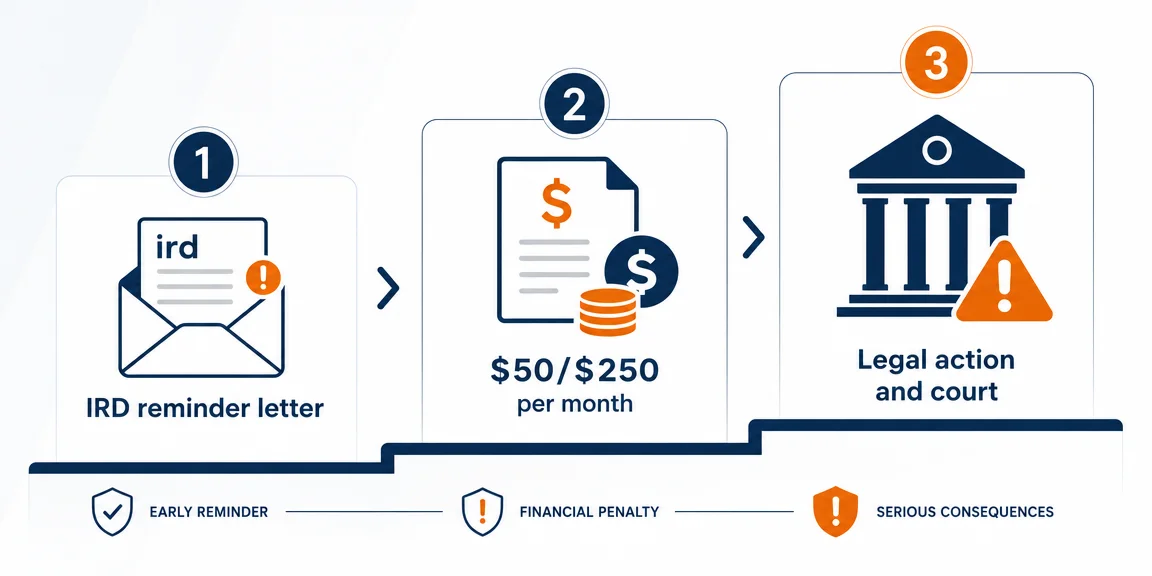
Getting your KiwiSaver obligations wrong carries real financial consequences.
Missed or late contributions:
- IRD will send reminders before escalating
- Penalty: $50 per month for small employers, $250 per month for larger employers
- Use-of-money interest applies on top of the missed amount
- Standard tax penalties also apply for late or non-payment
Repeated failures:
- IRD may take court action against your business
- Debt can be registered against the company
- A summary judgment can be issued
- Directors and shareholders can face personal liability for unpaid contributions
The most common mistakes NZ employers make:
- Not updating payroll to 3.5% after 1 April 2026
- Not enrolling eligible new employees from day one
- Failing to update ESCT rates annually
- Not issuing the KS3 pack within 7 days of a new employee starting
- Not refunding opt-out contributions promptly
- Missing the restart of deductions after a savings suspension ends
If you are not confident your current setup is correct, a compliance review is a good starting point. Our tax compliance services include an assessment of your employer KiwiSaver obligations and payroll structure.
Your 2026 KiwiSaver Employer Compliance Checklist
Run through this list to confirm you are meeting your obligations:
| # | Action |
|---|---|
| 1 | Update your payroll software to 3.5% employer contribution rate from the first pay date after 1 April 2026. |
| 2 | Check whether any employees aged 16 or 17 are already KiwiSaver members. Employer contributions now apply to them. |
| 3 | Verify ESCT rates are correct for each employee. Review annually and whenever salaries change. |
| 4 | Confirm all new employees receive the KS3 information pack within 7 days of starting. |
| 5 | Ensure KS2 deduction forms are completed. Default to 3.5% if the form is not returned. |
| 6 | File new employee details (name, address, IRD number) with IRD using the IR346K form. |
| 7 | Budget for the 1 April 2028 increase to 4% in your payroll forecasts. |
| 8 | Review employment agreements to confirm whether KiwiSaver sits on top of salary or within a total remuneration package. |
| 9 | Archive all KiwiSaver records (KS2, KS3, opt-out forms, suspension letters) for at least 7 years. |
| 10 | Speak to your accountant about ESCT optimisation and any employees with complex pay arrangements. |
Final Thoughts
The KiwiSaver landscape in NZ has shifted in 2026. The 3.5% rate is live. The 16 and 17-year-old employer obligation is active. And the move to 4% in 2028 is locked in.
Most compliance issues come down to two things: payroll systems that have not been updated, and employment agreements that have not been reviewed. Both are straightforward to fix. It is easier to address before IRD comes knocking than after.
At PAS, our Auckland-based team works with NZ businesses on payroll compliance, ESCT, and tax compliance across the board. If you are not confident your KiwiSaver obligations are being met, get in touch for a review.
Frequently Asked Questions
1. Is it compulsory for employers to contribute to KiwiSaver in NZ?
Yes. If an eligible employee is enrolled and contributing to KiwiSaver, you are legally required to make compulsory employer contributions. From 1 April 2026, the minimum is 3.5% of the employee’s gross salary or wages. This applies each payday. Failing to contribute can result in penalties and interest from IRD. A small number of exemptions exist. For example, if you are already contributing to an approved complying superannuation fund on the employee’s behalf.
2. What is the minimum KiwiSaver employer contribution in 2026?
From 1 April 2026, the minimum is 3.5% of the employee’s gross salary or wages, paid on top of regular pay. A further increase to 4% is legislated for 1 April 2028.
3. Do employers have to contribute for casual or part-time employees?
Casual employees are exempt from automatic enrolment. But if a casual employee has opted into KiwiSaver and is making contributions, the employer obligation applies. Part-time employees who are enrolled are treated the same as full-time staff. The 3.5% rate applies to their gross earnings regardless of hours worked.
4. What happens if an employer doesn’t pay KiwiSaver contributions?
IRD sends reminders first. Persistent failures attract penalties of $50 per month (small employers) or $250 per month (larger employers), plus use-of-money interest. Repeated failures can lead to court action, registered debt, or a summary judgment. Directors and shareholders can also face personal liability.
5. Can employers include KiwiSaver contributions within the employee’s salary?
Yes, but only with an explicit written agreement in the employment contract, negotiated before employment starts. Without this, the 3.5% employer contribution must be paid on top of salary. Many employers get this wrong. If in doubt, have your employment agreements reviewed.
6. What is ESCT and how does it work?
ESCT (Employer Superannuation Contribution Tax) is a tax on your employer KiwiSaver contributions before the money reaches the employee’s fund. The rate depends on the employee’s annual income and ranges from 10.5% to 39%. You deduct ESCT from your own contribution, meaning the net amount in the employee’s account is less than 3.5% of gross pay. Review ESCT rates annually.
7. Do employers have to contribute for employees aged 16 or 17?
From 1 April 2026, yes – if the 16 or 17-year-old is already a KiwiSaver member and making contributions from their pay. The auto-enrolment threshold remains at 18. But once younger workers have opted in themselves, your employer contribution obligation applies. Audit your payroll for any staff in this age group.
8. What is a KiwiSaver savings suspension and how do employers handle it?
A savings suspension lets a KiwiSaver member pause contributions for 3 to 12 months after 12 months of membership. The employee applies via IRD’s myIR portal. Once approved, IRD sends you a notice with the relevant dates. You stop deducting employee contributions and stop making employer contributions for the period. When it ends, IRD notifies you to restart. The employee’s net pay should increase during the suspension to reflect paused deductions.
Ready to get it right?
Book a payroll compliance review with the PAS team. We will check your contribution rates, ESCT calculations, employment agreements, and payday filing setup and flag anything that needs attention before it becomes a problem.